


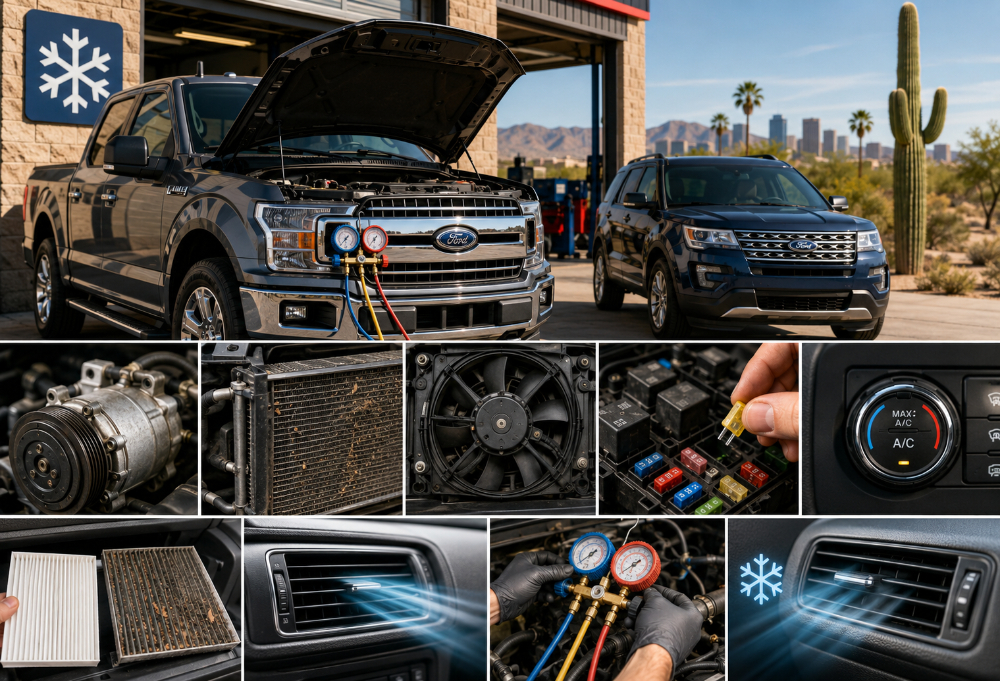
There is nothing quite like climbing into your Ford on a blazing summer afternoon, cranking up the AC, and feeling nothing but warm air blowing in your face. If you own a Ford F-150, Ford Explorer, or any other Ford vehicle and your AC not blowing cold air is ruining your daily commute, you are not alone. This is one of the most common complaints Ford owners bring to auto repair shops, especially in hot climates like Phoenix, AZ, where a functioning air conditioner is not a luxury; it is a necessity.
The good news is that most Ford AC problems are diagnosable and fixable. The bad news is that ignoring them can turn a simple, inexpensive fix into a costly repair. Understanding what causes your Ford AC to stop blowing cold air, and how much car AC repair typically costs, can help you make smarter decisions and avoid getting overcharged at the shop.
1. Low or Leaking Refrigerant: The Most Common Culprit
When your Ford AC is not blowing cold air, the first thing most technicians check is the refrigerant level. Refrigerant is the substance that makes the cooling process possible. Over time, small leaks can develop in the AC system, causing refrigerant levels to drop. Once refrigerant gets too low, the system cannot produce cold air no matter how high you crank the settings.
Refrigerant does not just evaporate on its own. If levels are low, there is almost always a leak somewhere in the system. Common leak points in Ford vehicles include the AC hoses, the condenser, and the evaporator core. In the Ford F-150 specifically, the evaporator is a frequent source of leaks because of its location inside the dashboard, where it is exposed to significant wear over time.
The fix for low refrigerant is an auto AC recharge, which involves removing the old refrigerant, checking for leaks, and refilling the system with the correct amount of refrigerant. A basic recharge typically costs between $150 and $300 at most shops. However, if a leak needs to be repaired before the recharge, costs can climb to $400 or more depending on where the leak is located and how accessible it is.
2. A Failing AC Compressor: The Heart of the System
The AC compressor is essentially the engine of your air conditioning system. It pressurizes the refrigerant and pushes it through the system so that heat can be removed from the cabin air. When the compressor fails or starts to wear out, cold air production stops almost entirely.
In Ford vehicles, compressor problems are often signaled by a few warning signs before complete failure. You might notice a grinding or squealing noise when the AC is turned on, or the AC may work intermittently, blowing cold air for a while and then switching to warm. Sometimes the compressor clutch, which is the component that engages the compressor, fails separately from the compressor itself. Replacing the clutch alone is cheaper than replacing the whole unit.
A full compressor replacement on a Ford F-150 or similar Ford SUV typically ranges from $800 to $1,500 depending on the model year and labor rates in your area. In a city like Phoenix, AZ, where shops handle high volumes of AC work, prices can vary widely, so getting two or three quotes before committing to this repair is always a smart move.
3. Condenser and Cooling Fan Issues
The condenser is the component that releases heat from the refrigerant after it has absorbed warmth from your car’s interior. It sits at the front of the vehicle, usually right behind the grille, which means it is exposed to road debris, insects, and other hazards that can cause damage or blockage over time. When the condenser gets clogged or cracked, the refrigerant cannot release heat efficiently, and the whole system suffers.
Cooling fans work alongside the condenser to pull air through it when the vehicle is stationary or moving slowly. If a cooling fan motor burns out or a fan blade breaks, the condenser cannot do its job properly, and your Ford AC will start blowing warm air even if every other component is working fine.
Condenser replacement on most Ford models costs between $400 and $900, including parts and labor. Cooling fan replacement is generally less expensive, running between $300 and $600. Because the condenser is so exposed to the elements, Ford owners in dusty or high-debris environments should have it inspected as part of regular AC service to catch issues early.
4. Electrical Problems and AC Controls
Modern Ford vehicles, including recent Ford F-150 trucks and Ford Expedition SUVs, rely heavily on electronic controls to manage the AC system. Sensors, relays, fuses, and control modules all play a role in keeping the system running properly. When any of these electrical components malfunction, the AC can stop working even if the mechanical parts are in perfect condition.
One common electrical issue is a blown fuse in the AC circuit. This is usually the cheapest fix in air conditioner troubleshooting, often costing less than $20 if it is only the fuse. However, if the underlying cause of the blown fuse is not addressed, it will keep blowing. Other electrical problems, such as a faulty pressure switch or a damaged control module, require more diagnostic work and can cost anywhere from $150 to $500 or more to repair.
Ford vehicles also use blend door actuators to control airflow temperature inside the cabin. A failed actuator can cause the system to blow only hot or only cold air regardless of the temperature setting. Blend door actuator replacement typically runs between $200 and $400, and in some Ford models, accessing the actuator requires removing significant portions of the dashboard, which adds to labor costs.
5. Cabin Air Filter and Airflow Restrictions
This one surprises a lot of Ford owners: a clogged cabin air filter can absolutely affect how cold your AC feels, even if the refrigerant levels and mechanical components are all fine. The cabin air filter catches dust, pollen, and debris before it enters the passenger compartment. When it gets too clogged, airflow through the AC system is restricted, making it feel like the AC is underperforming.
Replacing a cabin air filter is one of the easiest and most affordable parts of AC service. Most Ford vehicles have a filter that is accessible without tools, and the replacement filter itself usually costs between $15 and $40. If you have a shop do it for you, labor should add no more than $30 to $50. It is a small investment that can make a noticeable difference in how well your Ford AC blows cold air.
Beyond the cabin filter, debris buildup inside the evaporator housing can also restrict airflow and reduce cooling efficiency. Cleaning the evaporator and housing is more involved and typically costs between $150 and $300 at a professional AC service center.
Conclusion
If your Ford AC is not blowing cold air, the cause could range from something as simple as a clogged cabin filter to something as serious as a failed compressor. Staying on top of routine AC service, addressing small leaks before they grow, and getting proper air conditioner troubleshooting done by a qualified technician can save you hundreds of dollars over time. Whether you drive a Ford F-150 in Phoenix, AZ, or a Ford Explorer anywhere else in the country, keeping your AC in good working order is one of the best investments you can make in your vehicle’s comfort and reliability.
Need an Auto Repair Shop Near You?
At Saguaro Alignment & Brakes, we take pride in delivering dependable, honest, and efficient auto care to drivers throughout Phoenix, Arizona. Whether you need precise wheel alignment, reliable brake repair, A/C service, or full engine diagnostics, our experienced team is here to keep your vehicle performing at its best with quality workmanship and attention to detail. We are committed to making every visit smooth, transparent, and worthwhile, so you can drive away with confidence knowing your car is in good hands. When you are ready for service you can trust, reach out to us today to schedule your appointment or learn more about how we can help keep your vehicle running strong.